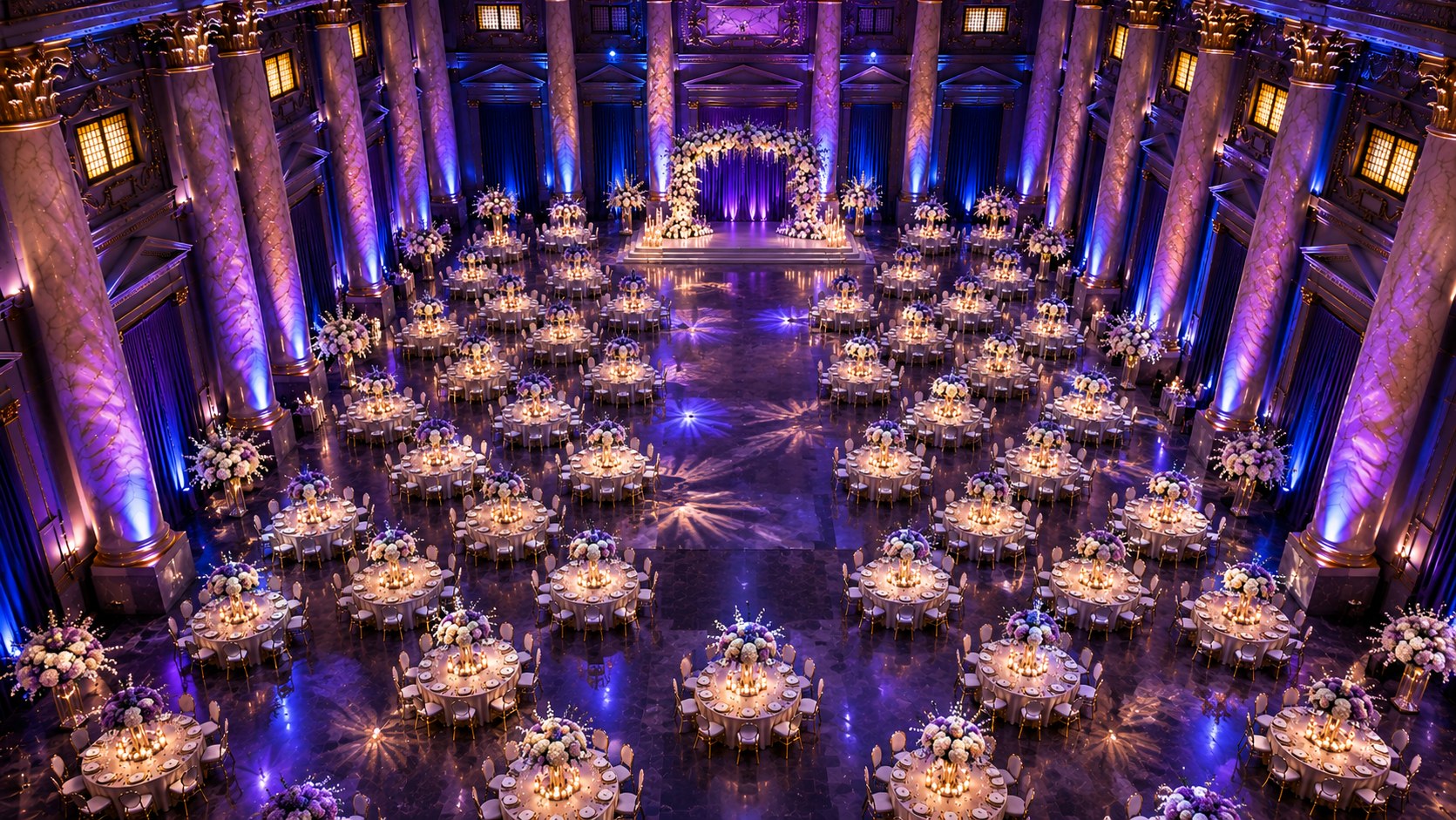
Guest count planning for a large NYC wedding starts with one distinction that most couples underestimate: seated and standing capacity are different numbers. A venue that seats 350 may hold 600 standing for a cocktail-style reception. Your guest count, your service style, and your venue's certified capacity must align before you send a single invitation.
This guide covers how to plan your guest count for a grand celebration — from estimating initial numbers and tracking RSVPs to locking the final headcount with your caterer. The goal is to arrive at a number that fits the venue, the kitchen, the dance floor, and the budget without surprises.
We do not claim any NYC venue can accommodate a specific guest count without verified evidence. All figures here are educational planning estimates. Always confirm seated and standing capacity in writing with each venue.
Balance your large guest list
Educational planning tool. Use this to brief your caterer and seating planner — final headcount must be confirmed with RSVPs.
Seated vs Standing: The Core Distinction
Seated capacity needs roughly 14 sq ft per guest for tables, chairs, and service aisles. Standing capacity needs roughly 7 sq ft per guest for circulation and high-tops. The same room may hold dramatically more standing than seated — but a seated dinner requires the full seated footprint.
Planning factors
- Seated: ~14 sq ft per guest (tables, chairs, aisles).
- Standing: ~7 sq ft per guest (circulation, high-tops).
- Hybrid: partial seating plus standing — splits the difference.
- Confirm both numbers in writing with each venue.
Educational estimate
Our featured Manhattan venue seats 550 or holds up to 1,500 standing — illustrating how wide the gap can be. Evaluate your count against both numbers.
Estimating Your Initial Guest Count
Start with your list, not a target number. Build your guest list by category — family, friends, colleagues, plus-ones — then estimate an acceptance rate. For a large wedding, plan for 80–85% acceptance of invited guests, adjusted for travel and season.
Estimation steps
- List every potential guest by category.
- Apply an acceptance rate estimate (80–85% for local, lower for travel).
- Add plus-ones per your policy.
- Round to a planning number for venue shortlisting.
- Re-estimate after RSVPs come in.
Guest distribution
Matching Count to Venue Capacity
Your guest count determines which venues can host your wedding. Shortlist venues whose certified seated capacity meets or exceeds your count with a 5–10% buffer. Never book a venue whose seated capacity equals your exact count — you need room for last-minute additions and comfortable circulation.
- Shortlist venues with certified seated capacity above your count.
- Build in a 5–10% buffer for last-minute changes.
- Confirm standing capacity if you plan a cocktail-style portion.
- Check fire-code maximum occupancy as a ceiling.
- Tour only venues that fit your count on paper.
Capacity guides
RSVP Management for Hundreds of Guests
Tracking RSVPs for 300+ guests requires a system. Use a spreadsheet or planning tool with categories, plus-one tracking, dietary notes, and a clear deadline. Follow up with non-respondents 2 weeks before the RSVP deadline to lock the count on time.
RSVP logistics checklist
- Set an RSVP deadline 3–4 weeks before the wedding.
- Track responses by category and plus-one status.
- Note dietary restrictions and accessibility needs.
- Follow up with non-respondents promptly.
- Lock the final headcount 7–10 days out for the caterer.
Count, Budget, and Service Style
Your guest count drives the budget more than any other variable. Per-guest costs — catering, rentals, bar, favors — scale linearly. Service style also interacts with count: plated service needs more staff per guest than buffet; standing receptions cost less per guest but need more bar and circulation space.
Budget and service
Locking the Final Headcount
The final headcount lock is the number the caterer uses to prepare. Lock it 7–10 days before the event, confirm it in writing, and understand the buffer policy — most venues allow a small adjustment after the lock, but not a large swing.
- 1Compile all RSVPs and plus-one confirmations.
- 2Confirm dietary and accessibility needs.
- 3Send the final headcount to the caterer 7–10 days out.
- 4Confirm table counts and the seating chart.
- 5Brief the venue on any last-minute changes within the buffer.
Frequently Asked Questions
Common questions about wedding guest count planning for large nyc weddings in NYC.