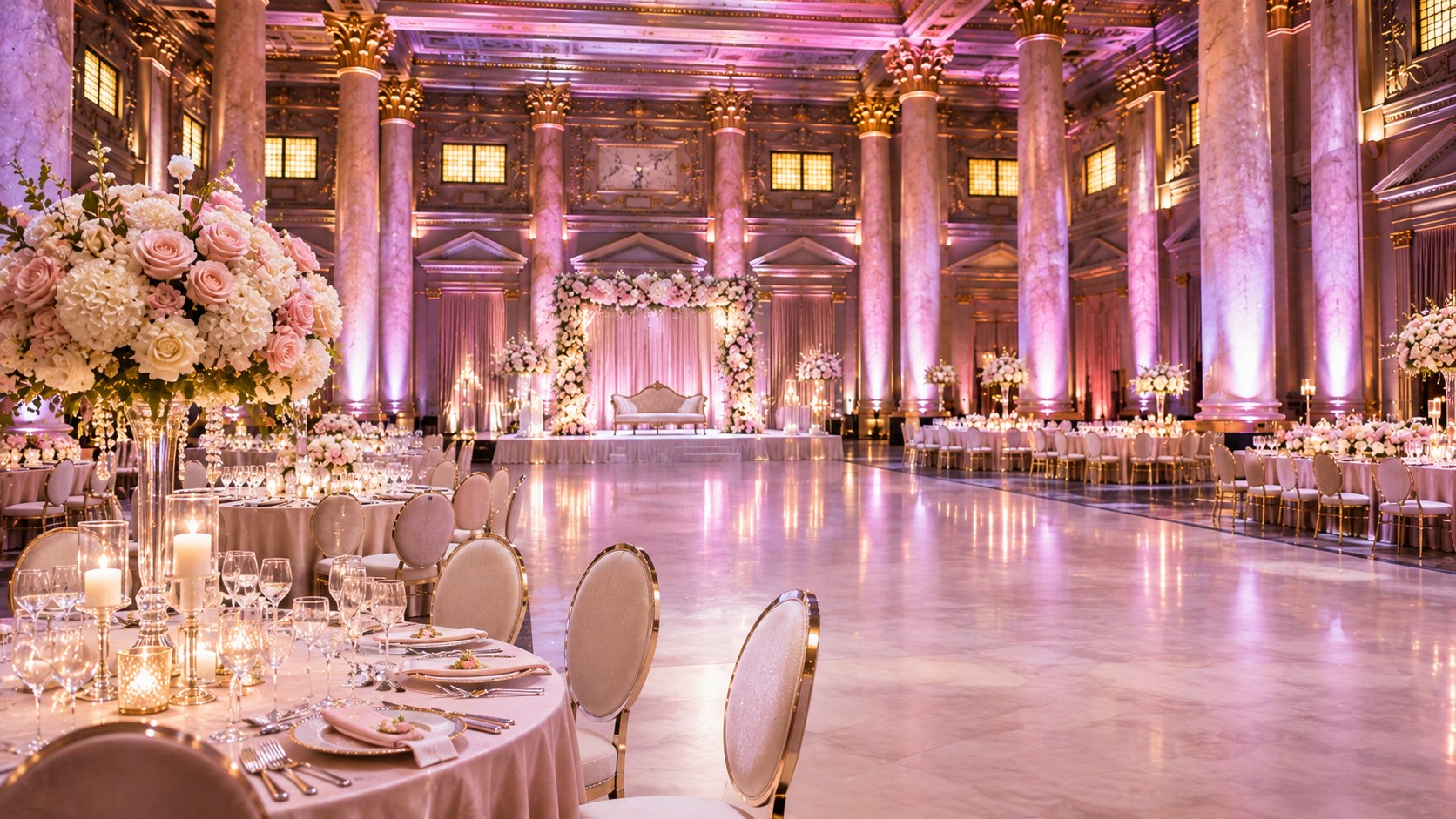
Planning a large wedding in NYC is a project, not a party. Once your guest list crosses 200 — and especially past 300 — the decisions that matter are logistical: which venue can actually hold the room, which kitchen can plate at scale, how 500 people move through one evening. This guide walks through how to plan a large wedding from the first decision to the final headcount.
We approach planning as a sequence of capacity-driven decisions. Every later choice — catering, seating, timeline, transportation — depends on the venue and guest count you lock in first. Skipping that order is how grand celebrations run into trouble.
We do not claim any NYC venue can accommodate a specific guest count without verified evidence, and we do not book venues or sell packages. This is a research and planning resource. When you are ready, start an inquiry.
Track your grand celebration
Start with Guest Count, Not Style
The single most important planning decision is your guest count, because it determines which venues can even host the event. A 400-guest wedding eliminates most NYC venues regardless of how beautiful they are. Build a realistic estimate early and refine it as RSVPs come in.
First decisions
- Estimate a realistic guest count range (e.g. 300–350).
- Decide seated vs. standing vs. hybrid reception format.
- Set a budget anchored to per-guest catering and venue cost.
- Choose a season and rough date window.
- Identify 2–3 NYC boroughs that fit your logistics.
Select a Venue That Matches Your Capacity
Venue selection for a large wedding is a capacity filter first, an aesthetic filter second. Shortlist venues with verified seated and standing capacity for your count, then evaluate floor plan, kitchen, dance floor, and accessibility. Never accept a single capacity number — ask for both seated and standing in writing.
Venue shortlist criteria
- Verified seated capacity for your guest count.
- Verified standing / cocktail capacity for the same room.
- Floor area that fits dining, dance floor, and stage.
- Commercial kitchen or commissary reheat capacity.
- ADA-compliant entrances, elevators, and restrooms.
- Load-in / load-out windows and freight access.
Lock the Layout Before the Decor
Once the venue is booked, lock the floor plan. Decide table style (rounds, banquet, or mixed), dance floor footprint, stage placement, bar locations, and service aisles. A floor plan drawn on a blank grid will fail in a real room — confirm it against the venue's certified dimensions.
- Choose table style and confirm table counts.
- Size the dance floor (min ~200 sq ft per 100 guests).
- Place the stage centrally with clear sightlines.
- Distribute bars (one per ~100 guests) away from the entrance.
- Reserve 4–6 ft service aisles between table rows.
Layout guides
Plan Catering and Service Logistics
Plating 300 or 400 dinners is an industrial operation. Confirm kitchen access, staff-to-guest ratios (1 server per 15–20 guests for plated service), and a synchronized 60–90 minute dinner window. Catering logistics decide whether dinner is on time or an hour late.
- 1Confirm on-site kitchen or commissary reheat capacity.
- 2Lock the service staff ratio for your guest count.
- 3Plan a synchronized 60–90 minute dinner window.
- 4Confirm bar staffing and glassware at scale.
- 5Send the final headcount 7–10 days out.
Build the Timeline and Coordinate Vendors
A large wedding runs on a master timeline. Map load-in, setup, ceremony, cocktail hour, dinner, toasts, dancing, and load-out with vendor cues. Distribute the timeline to every vendor and assign a day-of coordinator for 300+ guests.
Timeline and coordination
Plan Guest Logistics: Transportation, Registration, Accessibility
Moving hundreds of guests through one evening is its own logistics challenge. Plan transportation for the borough, a staffed registration and welcome desk, ADA accessibility, and circulation between ceremony, cocktail, and reception. Good guest logistics are invisible; bad logistics are the only thing guests remember.
Frequently Asked Questions
Common questions about how to plan a large wedding in nyc: a logistics-first guide in NYC.